
Strata Capital

Strata Capital

Strategic Wealth Management | Fairfield, NJ

  • The Firm
  • Our Approach
  • Our Services
    • For Corporate Professionals
    • For Entrepreneurs
    • For MetLife Employees
  • Why Us?
  • Insights
  • Contact Us
  • Client Login
  • Book Your Coaching Session
  • Strata Capital Home
  • The Firm
  • Our Approach
  • Our Services
    • For Corporate Professionals
    • For Entrepreneurs
    • For MetLife Employees
  • Why Us?
  • Insights
  • Contact Us
  • Client Login
  • Book Your Coaching Session
  • Strata Capital Home
  • Skip to main content

CrystalMarketing

4 Reasons to Quit Ignoring Your Deferred Comp Plan

By Carmine Coppola

If you work in corporate America, the probability that your company offers a deferred compensation plan is high. The term may be unfamiliar, but the concept probably isn’t. Deferred compensation is an arrangement that allows you to delay payment of a portion of your income until a later date when your taxable income—and related tax bracket—is likely lower. 

If that sounds like a 401(k) plan, you’re not wrong. A 401(k) falls under the category of qualified deferred compensation plans, which are those protected by the Employee Retirement Income Security Act of 1974 (ERISA). Qualified deferred compensation plans come with strict fiduciary standards, such as restrictions on contribution amounts and requirements to hold plan assets in a separate trust out of reach from the company’s creditors. These plans also come with strict rules that limit advantages for high earners.

Nonqualified Deferred Compensation Plans

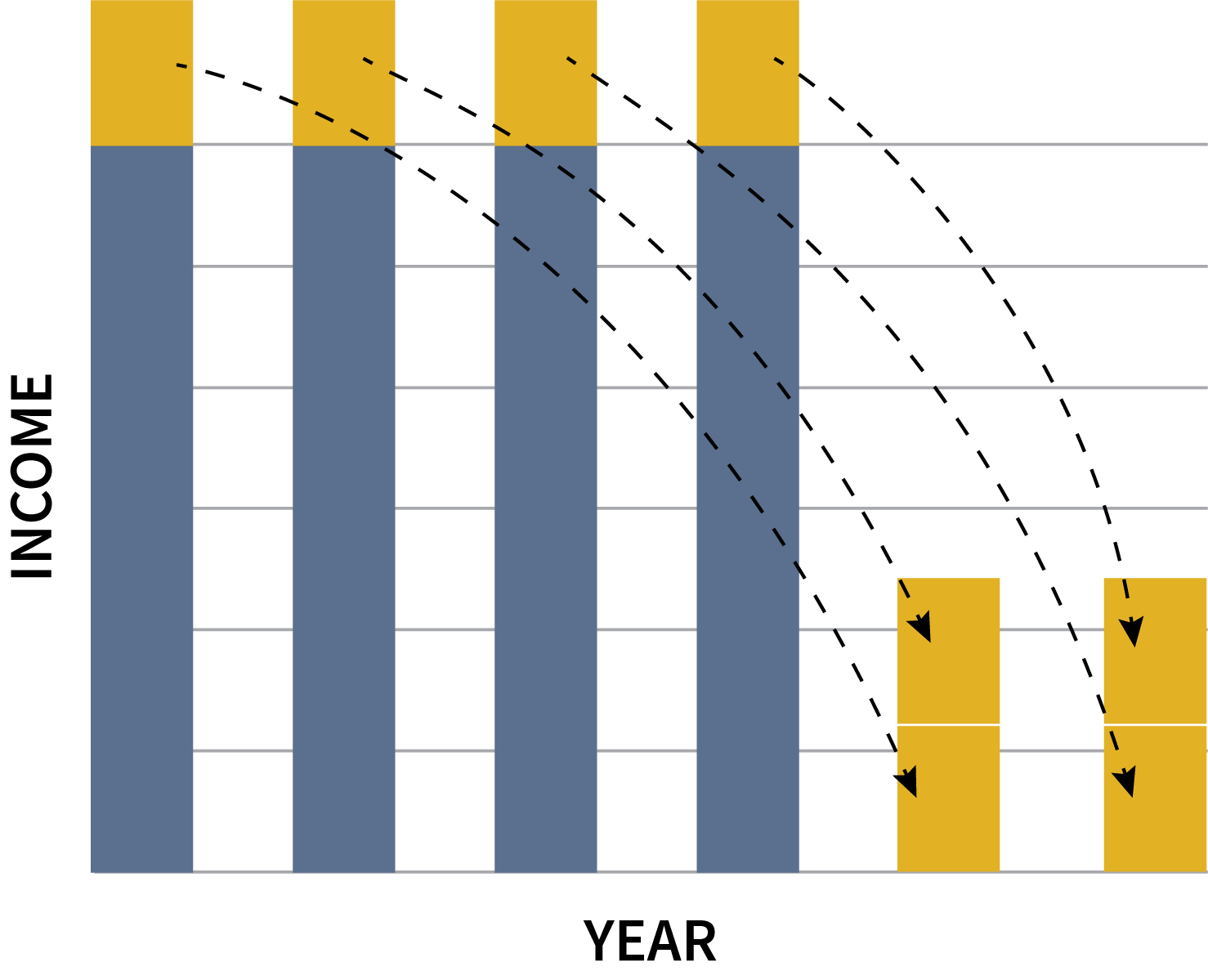
But a lesser-known and far more flexible tool is the nonqualified deferred compensation plan (NQDC), also known as elective deferral or supplemental executive retirement plans. These deferred compensation plans also allow you to pick investments and can even qualify for a company match (consider this a raise!); but unlike a 401(k) plan, a nonqualified deferred compensation plan places no limits on your contributions, no age restrictions on withdrawals, and no required minimum distributions. 

You can put away and invest an uncapped amount each year, reducing your taxable income by the amount you defer. You can enjoy tax-deferred investment growth until distribution, with flexibility on when you start receiving distributions – they can occur at retirement or sooner if you want to align payouts with other earlier financial goals. Distributions are taxed at ordinary income tax rates, so imagine how you can use this strategically alongside your tax planning.
nonqualified deferred compensation plan

It’s important to remember that all the potential benefits of NQDC plans come with some risks. It’s essentially an I.O.U. from the company; if they go bankrupt, your deferred compensation contribution is considered unsecured debt and could be lost. If a significant portion of your wealth is also held in stock options and restricted stock units, relying heavily on deferred compensation could mean too much of your financial well-being depends on the company’s financial strength. Moreover, effectively leveraging deferred compensation plans requires careful thought and planning. 

However, NQDC plans have been dubbed “golden handcuffs” for a reason. As a highly compensated employee, your work is a valuable asset to your employer, so the benefit is designed to incentivize retention. The more you make, the more you pay in taxes, and the more appealing the tax shelter is. If you intend to stay with the company, the financial advantages of using the plan strategically can be substantial and potentially well worth the carefully measured risk. 

Key Considerations for Deferred Compensation Planning 

You have some critical decisions when you elect to participate in a deferred compensation plan. Participation typically involves adhering to a designated enrollment period and establishing a written agreement with your employer. This agreement outlines crucial details, such as the amount of income to be deferred, the deferral period or schedule of distributions, and your investment choices. 

With so many possibilities and so much at stake, deferred comp plans can feel overly complex and even intimidating. The best way to start thinking about your strategic approach is to break it down into three main components:

  1. What do you want to use the deferred compensation for? 
  2. How much of your salary or bonus will you defer each year?
  3. When do distributions from the plan start, and how long do they last?

Once elections are made, they can be difficult or impossible to change, so you don’t want to go into this lightly. Before moving forward, it’s vital that you understand your options and look at the big picture.

We will explore four situations in which you can confidently and strategically leverage your nonqualified deferred compensation plan.

Strategy 1: Tax Reduction

Deferrals into an NQDC plan lower your taxable income in the year you defer income. So, if your total compensation was $300,000 and you decided to defer $25,000, your annual income would be $275,000. 

A common strategy we use is offsetting other income, such as stock compensation or inherited IRA withdrawals, with their deferred comp.

Let’s look at an example. 

Gianna’s salary and bonus are $550,000 per year. She also receives stock compensation in the form of RSUs (restricted stock units), which, on average, is about $50,000 per year. RSUs are taxed as ordinary income when they vest, regardless of whether you sell the stock. She inherited an IRA from her father and is currently withdrawing $25,000 per year, which will continue for the next several years. This puts her total income at $625,000, placing her in the highest federal tax bracket. Keeping tax calculations simple for this example, Gianni would pay $187,636 in federal taxes. Making her effective tax rate 30.7%

Gianna does not need the additional $75,000 in income from the RSUs and IRA distribution, so she is losing a ton of money to taxes on income she will not be using right now. What can she do?

Gianna’s company offers her a deferred compensation plan. She decides to defer $75,000 of her bonus each year. This will offset the amount she receives from the stock compensation and inherited IRA distributions. 

Why would she do this? Look at the chart below.

Deferred compensation strategy vs no strategy chart

As you can see, Gianna’s current plan puts her just over the threshold for the highest tax bracket. Deferring $75,000 of her compensation allows Gianna to reduce her taxable income to $550,000, keeping her just beneath the highest tax bracket. And her federal tax bill would be reduced to $160,690, saving her about $27,000 in federal taxes! This strategy allows her to maintain the same lifestyle spending, while the $75,000 she defers can be invested for retirement inside her NQDC plan. 

If she continues this over the next ten years, that is an additional $750,000 in retirement savings, not including any investment growth. She can do this without spending any less or adjusting her lifestyle now. She’ll also realize the potential advantage of paying less in taxes because when she takes the distributions, she will be retired and in a lower tax bracket. 

Strategy 2: Saving for Specific Goals

This strategy is simple and effective. All it takes is aligning your deferred compensation distributions with a specific goal in mind. This goal can be anything from your children’s education expenses to a down payment on a vacation home. Let’s show you how this concept works.

Bill and Laura have ambitious plans for their future. They want to make sure college expenses are covered for both children and purchase their dream vacation home. Their son will start college in eight years and their daughter in ten years, and they’d like to purchase their vacation home before the kids start college. 

Cash flow is great for Bill and Laura right now. Bill has a deferred compensation plan through his job, and he developed a strategy to defer his salary over the next six years to fund the couple’s goals.

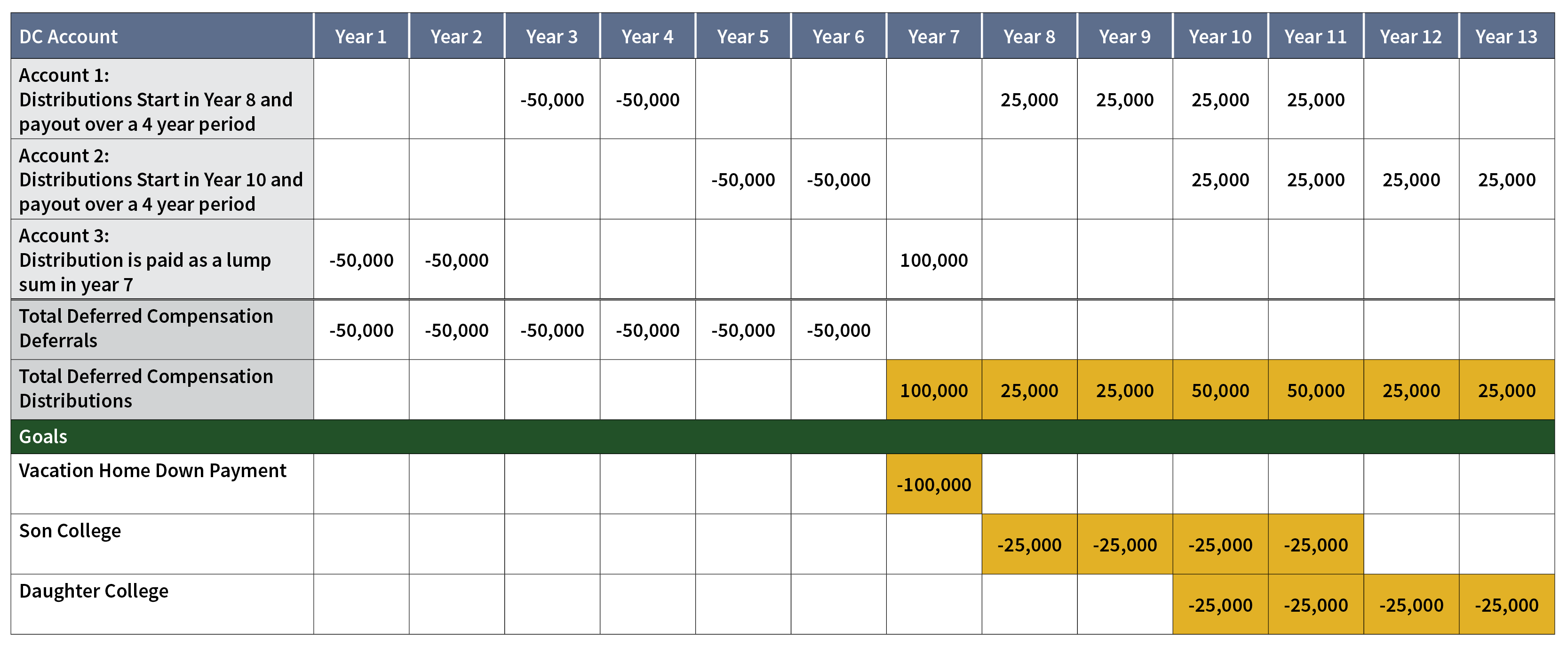
A common component of deferred compensation plans is the ability to have multiple accounts within the plan. Each account can have its own investment strategy and distribution schedule. When you make your elections, you decide which account you will be saving into. Bill’s plan allows him to save into three different accounts inside his deferred comp plan. 
Deferred compensation plan with multiple accounts

As you can see from the chart, Bill created three accounts — each with a specific goal in mind. Account #1 will begin paying out in Year 8, over four years to pay for his son’s college. Account #2 will begin paying out in Year 10, over four years to pay for his daughter’s college. Account #3 will be paid out in a lump sum in Year 7 to cover the down payment on the vacation home. 

Bill decides that deferring $50,000 per year into the accounts over the next six years will allow him to achieve his financial goals. Looking at the yellow boxes on the schedule, you can see that when distributions are made from the plan, they are each aligned with specific goals.

It’s important to note that we did not account for any investment growth in this example. This is something you should consider when determining if this strategy is right for you. Also, deferred compensation distributions are taxed as ordinary income, so being aware of what your total taxable income is likely to be at the time of distribution is also crucial. 

Strategy 3: Filling the Income Gap until Social Security

If you decide that you want to retire “early” or before age 65, the question most people ask is, “Where will my income come from?” Most people rely on Social Security to supplement their income in retirement. But how does that work if you retire earlier than you would like to begin drawing SSI or before you become eligible? 

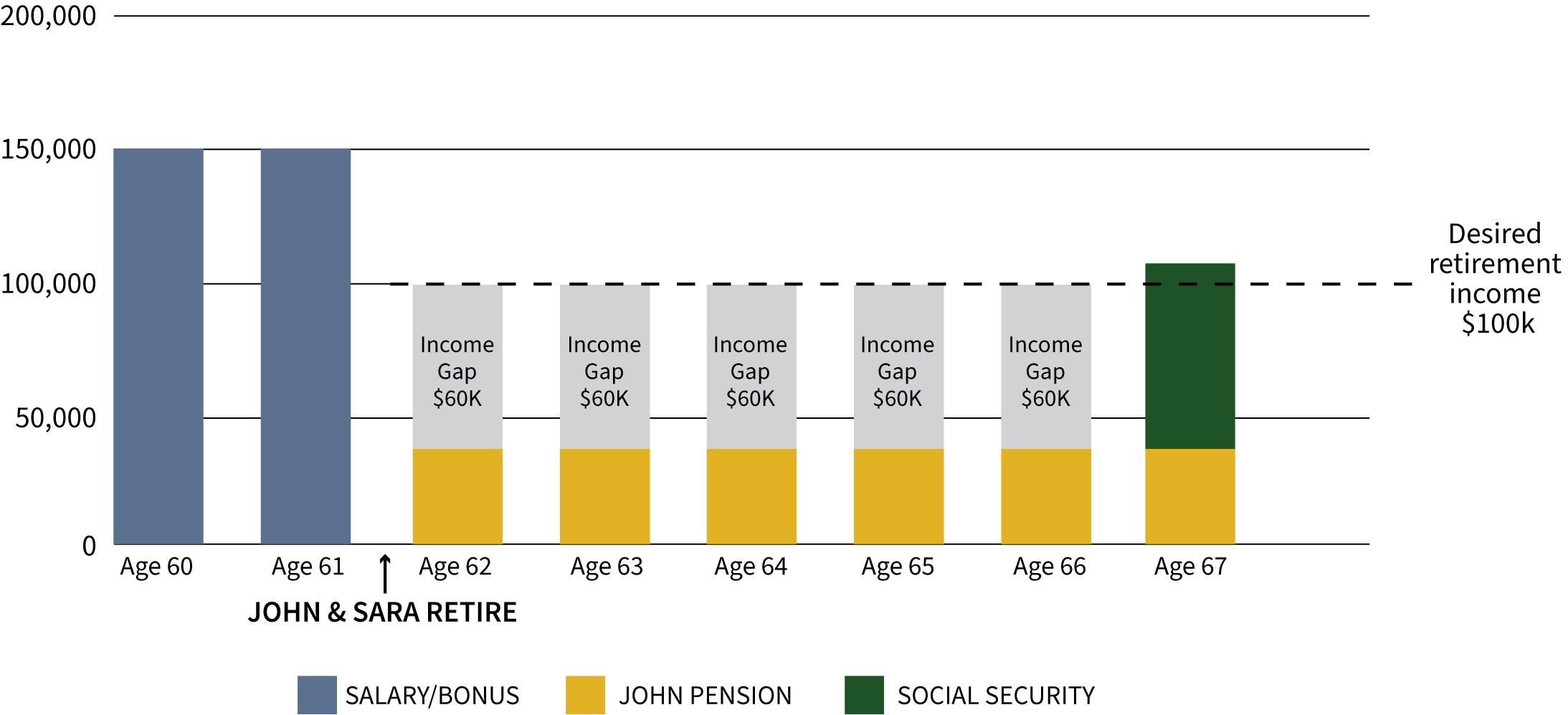
John and Sara are a married couple who are both 60 years old. They plan to retire when they are 62 and would like to wait until 67 to take Social Security. John has a pension that will start when he retires at age 62. 

This is what their projected income looks like right now:
Deferred comp income plan

You can see that John and Sara will have an income gap of $60,000 for the five years before Social Security kicks in. They will have to pull this from retirement accounts or other investments, which can lead to depleting assets sooner than anticipated.

Let’s examine an alternate scenario in which Sara utilizes the deferred compensation plan through her employer. In this example, Sara defers 50% of her yearly bonus until retirement. The deferred compensation plan is to be distributed over five years, starting when Sara reaches age 62. 

This is what their projected income looks like using Sara’s NQDC plan:

The gap they previously had to make up is now filled by Sara’s distributions from her deferred comp plan. This has a significantly positive impact on their future because now the couple can let their retirement and investment assets continue to grow over the five-year period and use those gains later to supplement their income. 

It’s important to remember that a deferred compensation strategy like this needs to be reevaluated each year. There are a lot of moving parts to your plan; to stay on track, you need to adjust as needed constantly. For example, you may have some unexpected expenditures that affect your cash flow and may need more money in your paycheck instead of deferring that compensation later. 

Strategy 4: Hedging for Getting Laid Off Early or Early Retirement

Let’s face it, companies go through layoffs and restructuring all the time. Unfortunately, the employees usually feel the most impact, especially the more highly compensated ones. Having a plan in place in the event you were to get laid off is essential to your financial well-being. The good news is if you have access to a deferred comp plan, it can be a great tool to hedge against uncertainty.

Let’s look at this in action. Mike has been a vice president at his company for the last ten years and is currently 55 years old. One of his major concerns is how an unexpected layoff would affect him and his family financially. To hedge against this possibility, he began deferring a portion of his bonus each year through his NQDC plan. He set the distribution date as the day he separates or retires from his company, and the distributions will be paid out over five years. The current value of the plan is $350,000. 

Looking at this chart, you can see that no matter when Mike leaves the company, he has a purpose for his deferred compensation. If he gets laid off at 58 (or any age, for that matter), the deferred comp will pay out over the next five years. Being that the current value is $350,000, that could be around $70,000 in income each year. This will allow him to buy some time while he looks for another job, or he could accept a job making less money since he has this income to supplement his pay. 

In the second scenario, Mike retires early at 62. He would receive his payout over the next five years until he is 66. The deferred compensation income would supplement his other retirement income until he takes Social Security. It could also pay for health insurance since he most likely would not be covered under his employer’s plan, and Medicare does not start until he is 65.

The last scenario has Mike retiring at the end of the year he turns 65, the longest he would continue working. If he’s able to stay that long, Mike could then use the deferred compensation to supplement his retirement income. This would enable him to withdraw less from his retirement and investment assets, allowing them to continue growing. He can also defer Social Security until 70 to max out his benefit since the NQDC payout would supplement his income in the meantime. The point is that Mike would have a lot of options and flexibility. 

Defer, Don’t Delay

Deferred compensation is a potent tool that necessitates a thoughtful approach. Carefully weigh your options and proceed with cautious enthusiasm — sooner rather than later. Defer your compensation, but don’t delay putting the plan to work for your future; remember, time is valuable. 

Decisions regarding deferred compensation plans should be intricately woven into the fabric of your comprehensive financial and retirement plans. Given the complexity and stakes involved, we recommend collaborating closely with a seasoned financial advisor to help navigate the myriad possibilities and make informed choices aligned with your long-term goals. 

As specialists in executive wealth planning, we offer a complimentary consultation to answer your deferred compensation questions. You can schedule a free session with our team here.


Strata Capital is a wealth management firm serving corporate executives, professionals, and entrepreneurs in the New York Tri-State Area, focusing on corporate benefits and executive compensation. Co-founded by David D’Albero and Carmine Coppola, the firm specializes in making the complex simple to ensure clients feel confident in their financial decisions. They can be reached by phone at (212) 367-2855, via email at carmine@stratacapital.co, or by visiting their website at stratacapital.co.

The opinions voiced in this material are for general information only and are not intended to provide specific advice or recommendations for any individual.

This material was prepared by Crystal Marketing Solutions, LLC, and does not necessarily represent the views of the presenting party, nor their affiliates. This information has been derived from sources believed to be accurate and is intended merely for educational purposes, not as advice.
Equity Compensation 101: How to Unlock the Wealth Potential of Your Stock Awards

By David D’Albero

When you reach a company’s top management or executive ranks, your compensation is often multifaceted. Smart employers recognize that high-caliber executives are pivotal in steering the company toward success. This is why executive compensation packages are carefully designed to attract, retain, and motivate top executive talent. 

Typical executive compensation packages include base salary, bonuses, stock options, deferred compensation, and additional benefits and perks, such as health insurance, retirement plans, and even personal use of corporate resources. In recent years, stock compensation has become increasingly popular because of its ability to align management performance with company performance while also cultivating a personal investment in the company’s success among leaders and key personnel.

Understanding the details of your equity compensation empowers you to directly tie your performance to company growth. This alignment then accelerates both organizational success and your own financial interests.

How Stock Compensation is Paid

Equity compensation serves as a long-term incentive, rewarding employees for their dedication over time. To receive full ownership of the stock, you must meet “vesting” requirements – essentially gaining a vested interest in the company through service over a defined period. Your vesting terms will outline when and how your equity compensation is paid out.

Vesting is structured in portions, typically following either a “cliff vesting” schedule or a “graded vesting” schedule.

With cliff vesting, you become 100% vested all at once after a set timeframe, usually three years. This structure requires you to stay with the company for that period before your incentive fully kicks in.

Graded vesting takes a phased approach, distributing ownership gradually at regular intervals over a timeframe of typically three to six years. For example, a five-year schedule might give you 20% equity per year. If you leave after three years under this model, you would vest 60% of the total compensation.

Now that we’ve covered some vesting basics let’s look closer at the different types of equity compensation and how they factor into your overall pay.

Restricted Stock, Restricted Stock Units, and Performance Shares

Equity programs serve strategic purposes like incentivizing loyalty and performance, as well as enhancing shareholder value. Companies offer various equity-based awards as part of executive pay. Let’s break down some key options.

Restricted Stock (RS)

With Restricted Stock, you receive actual company shares upfront, becoming a shareholder with voting rights and dividends. However, the shares get placed into an escrow account. You cannot access or sell them until vesting conditions are met.

Vesting terms often involve tenure thresholds, performance goals, or major company milestones such as a successful major product launch, merger, acquisition, sale, or IPO. These conditions encourage loyalty and achievement tied to shareholder interests.

You incur taxes on restricted stock when granted based on the fair market value. Additional tax events can follow at vesting triggers. Failing to meet vesting conditions (e.g., leaving the company before the shares vest, goals set are not met, or violating SEC trading restrictions) may forfeit the shares.

Restricted Stock Units (RSU)  

Restricted stock units differ from restricted stock, as they are typically reserved for executive-level members and board of directors only. However, RSUs still aim to incentivize loyalty, usually based on a time-based vesting schedule without other performance conditions.

Think of RSUs as a company’s promise to deliver a certain number of shares of company stock at a future date per the vesting terms. During the vesting period, you don’t participate in voting or dividends. The share transfer and tax obligations only happen at completion. 

RSUs are treated as ordinary income in the year the award vests, as opposed to when they are awarded. They focus on tenure-based loyalty over added performance milestones. But, leaving the company early can still result in forfeiture.

Performance Shares

Performance Shares take a results-driven approach. Rather than time-based vesting, earning these rights hinges on achieving predefined targets – tying rewards directly to company and individual performance.

The better you perform against set objectives, the more shares you receive. This links compensation to strategic goals beyond just retention incentives.

Tax Considerations

The tax process aligns across equity compensation programs. To calculate ordinary income, subtract the purchase cost or exercise price from the fair market value (FMV) at vesting.

If you sell the stock later, the difference between the sale price and FMV gets treated as a capital gain or loss. The holding period past vesting categorizes it as short or long-term.

Stock Options

Stock options give employees the right (but not requirement) to purchase company shares at a set price within a defined timeframe. They aim to attract and retain top talent.

Allocation is often tied to role seniority. For instance, a standout VP prospect could receive options equating to 1-2% ownership, while CEO packages may encapsulate 5-10% or more. These numbers fluctuate widely depending on factors like company stage, industry, and specific hiring needs.

Non-Qualified Stock Options (NQSOs) 

Non-qualified stock options (also called non-statutory options) provide the right to buy company shares at a set “exercise” or “strike” price. These options face fewer tax and vesting restrictions than incentive stock options.

Incentive Stock Options (ISOs) 

Incentive Stock Options also grant purchase rights at predetermined prices. But ISOs come with special IRS rules around vesting periods and holding times which are designed to incentivize you by linking your financial benefit to the company’s long-term performance. You need to meet the requirements to receive preferential tax treatment.

Tax Considerations 

The main variance between NQSOs and ISOs comes down to taxes. With non-qualified options, the spread between fair market value and your exercise price gets treated as immediate ordinary income. This amount is subject to ordinary income tax and, in some cases, Social Security and Medicare taxes as well.

But incentive stock options become more advantageous if you hold the shares for at least one year post-exercise and two years after receiving the options. Hitting these milestones unlocks preferential long-term capital gains rates at sale or trade, allowing you to maximize gains.

Stock Appreciation Rights (SARS)

SARs are a form of employee compensation that provides the potential upside of stock value gains without having to purchase shares. You receive the appreciation between grant and exercise prices, settled in either cash or stock.

For example:

Company X grants 1,000 SARs when shares trade at $20. After three years, the stock reaches $40 and the rights become vested and exercisable.

At that point, you could take $20,000 cash (1,000 x $20 price appreciation). Or 500 shares via the share equivalent ($20,000 at $40 per share).

Either way, the profit gets taxed as ordinary income when you exercise SARs. These rights aim to incentivize holders through stock growth without diluting ownership.

Employee Stock Ownership Plan (ESOP)

ESOPs are a type of retirement plan that enables employees to become partial owners of the company by acquiring shares of company stock. ESOPs aim to foster a sense of ownership and align employee interests with company performance.

Shares get awarded into an ESOP trust and then allocated to individual accounts per a predetermined formula factoring criteria like salary and tenure.

Upon leaving the company, employees receive the value of their vested ESOP shares, distributed in cash, stock, or both. These disbursements count as ordinary income, except for IRA rollovers or utilizing Net Unrealized Appreciation (NUA).

NUA allows unique tax treatment where just the initial stock cost basis faces income tax while gains qualify for long-term capital rates. For example, an employee retiring after 30 years has a $1M ESOP balance with a $250k cost basis. They could take $250k as income and $750k at preferential capital rates.

The NUA strategy has many complexities, so guidance from financial and tax advisors is critical for proper execution.

Managing Your Stock Compensation

Equity awards unlock immense wealth potential through company ownership and preferential tax treatment. When strategically managed, they can accelerate reaching your biggest financial goals.

Deferred compensation programs, in particular, let you postpone income tax while holdings potentially appreciate over the long term. This has the potential to compound gains dramatically compared to immediate income recognition.

The key lies in navigating vesting milestones, tax implications, holding periods, and more to optimize these programs for your situation. With the right guidance, equity compensation can shift your finances into overdrive.

As specialists in executive wealth management, Strata Capital understands both the immense opportunities and complexities of equity compensation. We help corporate leaders maximize the value of their compensation package through strategic tax planning, deferred income optimization, and other financial strategies. If you are ready to unlock the full potential of your shares, options, or performance awards, contact us today to schedule a complimentary consultation.


Strata Capital is a wealth management firm serving corporate executives, professionals, and entrepreneurs in the New York Tri-State Area, focusing on corporate benefits and executive compensation. Co-founded by David D’Albero and Carmine Coppola, the firm specializes in making the complex simple to ensure clients feel confident in their financial decisions. They can be reached by phone at (212) 367-2855, via email at carmine@stratacapital.co, or by visiting their website at stratacapital.co.

Cornerstone Planning Group, Inc., (“CSPG”) is an SEC registered investment advisory firm. The information contained herein should not be construed as personalized investment advice and should not be considered as a solicitation for investment advisory service. The information (e.g., tax ) provided is believed to be accurate however CSPG does not guarantee or otherwise warrant such information. For more information regarding CSPG you can refer to the Investment Adviser Public Disclosure website (www.adviserinfo.sec.gov) and review our Form ADV Brochure and other disclosures.

The opinions voiced in this material are for general information only and are not intended to provide specific advice or recommendations for any individual.

Practical and Creative College Funding Strategies | Strata Capital

https://stratacapital.co/wp-content/uploads/2024/01/How-to-fund-education.mp4

Is your child’s college savings on track? In this video, Carmine Coppola sheds light on practical solutions for parents saving for their children’s college education. He explores various strategies for effectively managing college funds, including utilizing existing assets, family contributions, and student loans. 

Topics Discussed:

  • Determining if current educational savings are adequate
  • Other assets to consider putting towards college savings
  • Family contributions to college fund
  • Student loans as a last resort

▬▬▬▬▬▬▬▬▬▬▬▬▬▬▬▬▬▬

➡️ SUBSCRIBE for more FREE tips

➡️ Schedule your introductory appointment now: https://stratacapital.co/contact-us/

➡️ Learn more about us at https://stratacapital.co/

▬▬▬▬▬▬▬▬▬▬▬▬▬▬▬▬▬▬

Strata Capital is a wealth management firm serving corporate executives, professionals, and entrepreneurs in the New York Tri-State Area, focusing on corporate benefits and executive compensation. Co-founded by David D’Albero and Carmine Coppola, the firm specializes in making the complex simple to ensure clients feel confident in their financial decisions. They can be reached by phone at (212) 367-2855, via email at carmine@stratacapital.co, or by visiting their website at stratacapital.co.

The opinions voiced in this material are for general information only and are not intended to provide specific advice or recommendations for any individual.

The information contained above is for illustrative, educational, and informational purposes only and does not constitute investment advice and it should not be relied on as such. It should not be considered a solicitation to buy or an offer to sell a security. It does not take into account any investor’s particular investment objectives, strategies, tax status or investment horizon. You should consult your attorney or tax advisor.

Cornerstone Planning Group, Inc., (“CSPG”) is an SEC registered investment advisory firm. The information contained herein should not be construed as personalized investment advice and should not be considered as a solicitation for investment advisory service. The information (e.g., tax ) provided is believed to be accurate however CSPG does not guarantee or otherwise warrant such information. For more information regarding CSPG you can refer to the Investment Adviser Public Disclosure website (www.adviserinfo.sec.gov) and review our Form ADV Brochure and other disclosures.

Easing Financial Worries: Strategies for Stressing Less about Money

By Carmine Coppola

Money can be a real stressor for many of us, especially when juggling multiple responsibilities. The worries around finances, including income, debts, savings, and managing expenses, can take a toll on our mental and physical well-being. Whether it’s dealing with economic uncertainties, job insecurities, or balancing various financial obligations, it’s quite the load to carry.

The good news? You’re not alone in this, and practical ways exist to ease this stress. Let’s explore some strategies together that can truly make a difference.

Get Organized

Understanding your current financial situation is like having a roadmap to navigate through the stress. Take some time to gather information about your income sources, debts, expenses, savings, investments, and retirement plans. Simplify it by jotting down where your accounts are, what types they are (like individual or 401(k)), and who manages them. This simple step can provide a clearer picture of where you stand financially.

Tackle Debt

Debt can be overwhelming, but breaking it down can make it more manageable. For those revolving credit card debts, noting each card’s interest rate and minimum payment can be an eye-opener. If you want to take advantage of one of the common solutions for attacking revolving debt, consider taking out a consolidation loan or a balance transfer. The consolidation can work if the interest rate is lower than the current weighted rate and the payment is the same or less. If you go with a balance transfer, make sure you devise a plan to pay off the debt before interest is due. Designing a pay schedule is the best way to implement this. 

Listing balances, interest rates, and payments is a smart move for installment debts like mortgages or car loans. Exploring consolidation or calculating how extra payments could shrink those balances faster might be beneficial. For this type of debt, you can also shop it out to see if it makes sense to consolidate everything, or maybe a portion of it, for a lower interest rate. You can even run calculations to see how quickly extra payments would pay down your balances.

Remember, paying off debt takes time, so patience is key here.

Create a Budget Based on Cash Flow 

At the core of any financial plan lies understanding your cash flow – what comes in and what goes out. Conducting a cash flow analysis can shed light on your monthly income and expenses. By prioritizing needs like mortgage, utilities, and food and balancing them against debt payments, you’ll get a clearer idea of how much extra you have for paying down debt, starting an emergency fund, or saving for retirement and other needs.

Creating a budget based on this information and sticking to it can significantly reduce stress. It’s not about restricting yourself but being responsible with what you have. Working with actual dollars rather than wishful thinking can make all the difference on the path to financial independence.

Simplify. Simplify. Simplify.

Sometimes, we can overly complicate our financial situations, leading to bad habits or bad financial decisions. We are firm believers in less is more. Here are some steps that can help you nurture healthier financial habits:

Simplify Credit Cards

Ever found yourself juggling multiple credit cards for various purposes? After implementing the steps to manage your debts, it’s time to get specific about which card serves what purpose. Maybe one for everyday expenses, another for travel, and one dedicated to shopping? Assigning purposes makes tracking expenses easier, and, remember, the golden rule is always to pay the balance before the interest clock starts ticking.

Simplify Investment Accounts

Maintaining a unified investment strategy demands dedication and effort. Why make it harder by scattering your investment strategy across various accounts? Consider this scenario: when leaving a job, many individuals leave their 401(k) behind. Fast forward a decade, and you might find yourself managing three separate 401(k) accounts. Updating your investments then means juggling between three different places. Work with a financial advisory firm, such as Strata Capital, to strategically streamline and consolidate these accounts to simplify management and potentially reduce associated fees.

Simplify Bank Accounts

Let’s circle back to our cash flow discussion. Too many bank accounts can add unnecessary confusion to bill payments and expense tracking. Simplify your accounts with intention. Consider a spending account for day-to-day expenses, a separate one for bills, and another for savings. This clear division helps you stay on top of your financial game.

Start Building Wealth

Once you’ve taken strides to reduce debt or organize your spending, it’s time to step into the world of wealth building. Building wealth isn’t just about buying luxurious items; it’s about fostering a sense of security and confidence in your financial future. Begin by establishing an emergency reserve account to use as a safety cushion against unforeseen financial hurdles.

Remember, building wealth is a long-term game that requires commitment and action. Your future self will appreciate the steps you take today. It’s crucial to act decisively and set your plans into motion. These strategies aim to offer a brighter outlook on financial management, empowering you to seize control of your financial well-being!


Strata Capital is a wealth management firm serving corporate executives, professionals, and entrepreneurs in the New York Tri-State Area, focusing on corporate benefits and executive compensation. Co-founded by David D’Albero and Carmine Coppola, the firm specializes in making the complex simple to ensure clients feel confident in their financial decisions. They can be reached by phone at (212) 367-2855, via email at carmine@stratacapital.co, or by visiting their website at stratacapital.co.

The opinions voiced in this material are for general information only and are not intended to provide specific advice or recommendations for any individual.

This material was prepared by Crystal Marketing Solutions, LLC, and does not necessarily represent the views of the presenting party, nor their affiliates. This information has been derived from sources believed to be accurate and is intended merely for educational purposes, not as advice.

Strategically Using 401(k) After-Tax Contributions to Boost Retirement Savings

Retirement is expensive. If you want to recreate your income in retirement, you’ll need to save an average of 10-15% of your income throughout your career. But it’s no secret that most people either get started late or find themselves tracking behind their targets late in the game. At some point, you may realize that hitting your numbers might require being more aggressive than planned. But how should you go about doing this? One of the most overlooked and underutilized strategies available for employees to get on track is the 401(k) after-tax contribution. 

What Are 401(k) After-Tax Contributions?

In addition to the traditional pre-tax and Roth contributions, most plans also allow for  401(k) after-tax contributions. It’s called “after-tax” because the money contributed has already been subjected to income tax at the time of deposit, which means it doesn’t provide an immediate tax deduction like pre-tax contributions. However, the earnings on after-tax contributions grow tax-deferred within the 401(k) account, just like pre-tax contributions. They are also subject to income tax when withdrawn in retirement.

So Why Use 401(k) After-Tax Contributions?

1. Higher Contribution Limits

The IRS has annual contribution limits for 401(k) plans, which include a limit on pre-tax and Roth contributions. The combined limit for 2023 pre-tax and Roth contributions is $22,500 per year, or $30,000 if you’re age 50 or older. 

However, 401(k) after-tax contributions allow you to save more for retirement if you have the means to do so. The 2023 401(k) total contribution limit, including after-tax contributions, is much higher—up to $66,000 or 73,500 for those aged 50 or older. 

2. Conversion to Roth

You can convert your 401(k) after-tax contributions into a Roth IRA or Roth 401(k) when you leave your job or if your plan allows in-service conversions. Some plans will even let you do this internally. 

Roth conversions can be valuable for building a tax-free retirement income stream. Since after-tax contributions have already been taxed, the conversion to a Roth account won’t trigger additional taxes. 

There’s only one exception to consider: if you’ve generated earnings on your after-tax contributions, which may happen if the funds have been sitting in the account for a while. This doesn’t mean you can’t do the conversion; it simply means that those earnings must be rolled into a traditional IRA to avoid taxation. 

In short, your contributions can go to the Roth account, and any earnings will go to a traditional pre-tax IRA. 

3. Tax-Deferred/Tax-Free Growth

Much like pre-tax and Roth contributions, 401(k) after-tax contributions can grow tax-deferred until you withdraw the funds in retirement. This means your retirement savings have the opportunity to grow more efficiently over time. 

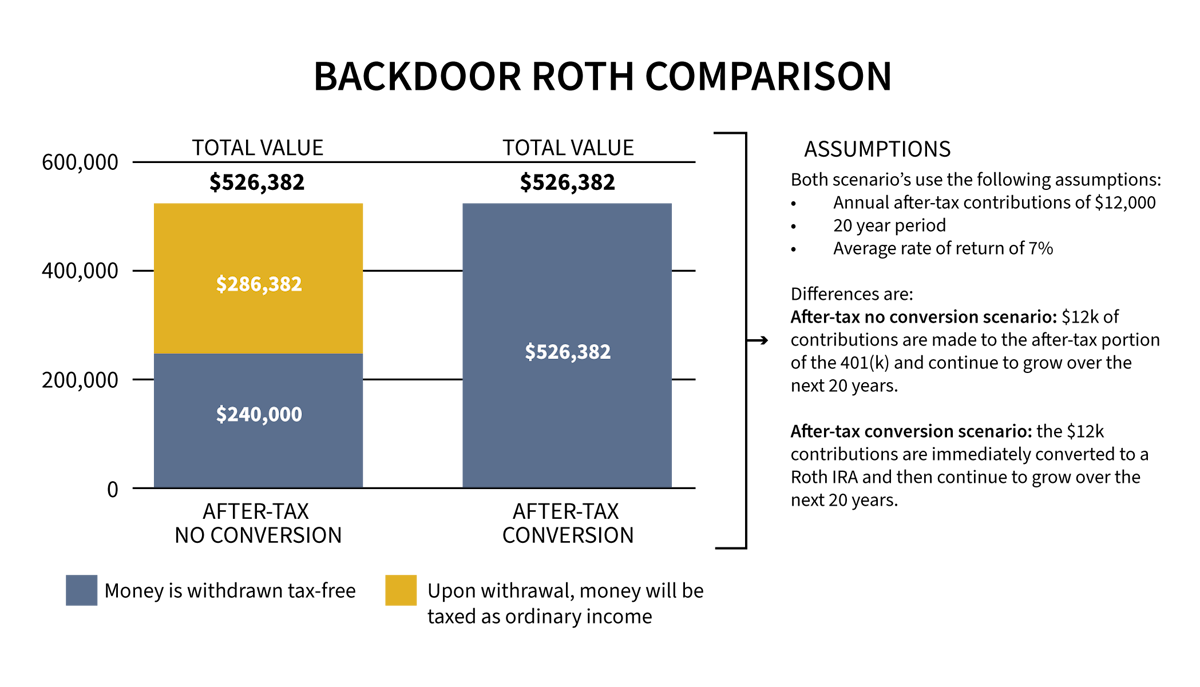
If your plan permits, you may be able to move the funds to a Roth account shortly after you’ve made your contribution. This is called a mega backdoor Roth. Funds will have the opportunity to grow not only tax-deferred, but the withdrawals will also be tax-free. Check out our blog on back-door Roth contributions to learn more about this strategy. 

Backdoor Roth Comparison

4. Employer Match 

If you’re not taking full advantage of your employer match, you’re leaving lots of money on the table. Some employers provide a matching on 401(k) after-tax contributions, similar to how they match pre-tax contributions. 

Remember, an employer match provides an immediate return on your investment, so check into your employee benefits and make certain you aren’t missing out on this valuable perk. 

Are You Considering 401(K) After-Tax Contributions?

As a strategy, 401(k) after-tax contributions can considerably impact a retirement savings plan. But before you begin contributing, review your current cash flow to determine whether contributing extra dollars is reasonable. Prioritizing your family’s stability is key. While making sacrifices can lead to rewards, it’s essential first to secure your emergency savings and meet your immediate needs.

Before making any decisions, remember that company rules and federal laws governing 401(k) plans can change. If you’d like to discuss your situation with a financial advisor, schedule a meeting with us. Together, we can explore how after-tax 401(k) contributions can enhance your overall retirement and tax planning strategy. Let’s connect and discuss how we can optimize your financial future.

Strata Capital is a wealth management firm serving corporate executives, professionals, and entrepreneurs in the New York Tri-State Area, focusing on corporate benefits and executive compensation. Co-founded by David D’Albero and Carmine Coppola, the firm specializes in making the complex simple to ensure clients feel confident in their financial decisions. They can be reached by phone at (212) 367-2855, via email at carmine@stratacapital.co, or by visiting their website at stratacapital.co.

The opinions voiced in this material are for general information only and are not intended to provide specific advice or recommendations for any individual.

This material was prepared by Crystal Marketing Solutions, LLC, and does not necessarily represent the views of the presenting party, nor their affiliates. This information has been derived from sources believed to be accurate and is intended merely for educational purposes, not as advice.

Navigating the New Trend That Is Semi-Retirement

In a world where the traditional concept of retirement is evolving, semi-retirement has emerged as a popular alternative to full retirement. In fact, according to a recent study by Paychex, as many as 1 in 6 retirees are choosing to continue working in some capacity. Semi-retirement offers retirees the opportunity to maintain a sense of purpose and stay active while allowing them to enjoy leisure activities. 

But before you decide to take the plunge into semi-retirement, there are several important considerations to keep in mind. To make a well-informed decision about semi-retirement, consider the following points.

Financial Assessment

When transitioning to semi-retirement, a thorough evaluation of your financial situation is needed. If you have planned well, you may have enough income to support your lifestyle with various income streams, such as pensions, social security, investment income, deferred compensation, and retirement plans. Many individuals in this situation choose employment not out of financial necessity but as a way to keep active and engaged, with the added perk of having a little extra ‘pocket change.’ 

A trend we’ve seen with our clients in the post-Covid era is a desire to retire early from their current career and work longer in a part-time job they find more enjoyable. For example, let’s say your planned retirement age is 65. After running an analysis, we determine that you could semi-retire at 63 and work part-time until 70. Would you do it? Many of our clients are considering this as an option. When asked why they would want to work longer, the most common answer is, “I just need to get out of the rat race. I don’t dislike working; I dislike the stress.”

However, if you plan on collecting Social Security before full retirement age and are generating an income through employment, you will need to consider how your income will affect your benefits. For 2023, the annual income limit for social security is $21,240. For every $2 you earn above the limit, Social Security will deduct $1 from your benefit payment.

Health Insurance and Benefits

One of the most important considerations before embarking on semi-retirement is its effect on health insurance coverage and other benefits your employer offers—especially if you are considering entering semi-retirement before age 65. If you plan to reduce your hours at your current job, will your health insurance and other benefits still be available? If you plan to leave your current job and work somewhere else part-time, what benefits will your new employer offer? 

Some options for replacing health insurance coverage include utilizing a spouse’s coverage if they are still working, utilizing your company’s retirement health benefits if you have access, and investigating the options for private health insurance. Another option could be using your employer’s COBRA coverage to bridge the gap to Medicare eligibility, depending on when you plan to transition to semi-retirement. Our advice here is always the same: investigate every option so you can compare the premium costs, out-of-pocket costs, and access to doctors.    

Lifestyle and Activities

Semi-retirement opens doors to explore new interests or hobbies or even pursue part-time work in a field that resonates with your values or has long captured your imagination. Reflect on the activities you’d like to engage in during your semi-retirement years. Whether traveling, volunteering, starting a small business, or spending more time with family, having a clear vision of your desired lifestyle will help you make the right decisions as you transition.

Social and Emotional Considerations

Work often provides a sense of purpose and social interaction. As you contemplate semi-retirement, consider how this change might impact your sense of identity and social connections. Even if your current job is stressful, will stepping back mean losing that sense of significance you’ve grown accustomed to in your professional life? Retiring from a full-time job can also mean losing the structured routine that your work provides, along with intellectual stimulation and continuous learning opportunities that come with new challenges. Engaging in social activities, networking events, or joining clubs can help you maintain a fulfilling social life. 

In addition, consider the fact that you’ve been at work for over 40 hours a week for the past few decades and, if you decide to fully retire, will be spending a lot more time with your spouse. Working a job, even part-time, will provide time for both of you to adjust to spending more time together.

Be Flexible

Flexibility is key when transitioning to semi-retirement. Life is unpredictable, and circumstances can change. It’s important to remain adaptable to new opportunities and challenges that may arise. If necessary, be prepared to adjust your plans and have contingency plans to address unexpected financial or personal changes.

Navigating Semi-Retirement Successfully

Semi-retirement can offer a fulfilling and balanced lifestyle for those seeking a new chapter in their lives. However, it’s a decision that requires careful consideration of financial, lifestyle, social, and emotional factors. By thoroughly assessing your situation and priorities, you’ll be better equipped to make an informed choice that aligns with your aspirations and ensures a prosperous semi-retirement journey. Remember, the key is to plan ahead, be flexible, and embrace the possibilities that semi-retirement can bring.


Strata Capital is a wealth management firm serving corporate executives, professionals, and entrepreneurs in the New York Tri-State Area, focusing on corporate benefits and executive compensation. Co-founded by David D’Albero and Carmine Coppola, the firm specializes in making the complex simple to ensure clients feel confident in their financial decisions. They can be reached by phone at (212) 367-2855, via email at carmine@stratacapital.co, or by visiting their website at stratacapital.co.

The opinions voiced in this material are for general information only and are not intended to provide specific advice or recommendations for any individual.

This material was prepared by Crystal Marketing Solutions, LLC, and does not necessarily represent the views of the presenting party, nor their affiliates. This information has been derived from sources believed to be accurate and is intended merely for educational purposes, not as advice.

  • « Go to Previous Page
  • Go to page 1
  • Go to page 2
  • Go to page 3
  • Go to Next Page »
Strata Capital

Subscribe to Our Blog

This field is for validation purposes and should be left unchanged.

Disclosures      ADV      CRS

350 Passaic Avenue, Suite 201 | Fairfield, NJ 07004 | 212-367-2855 | Email David | Email Carmine

Copyright © 2025 Strata Capital

Privacy Policy | Terms of Use

Advisory services are provided through Cornerstone Planning Group, LLC, an independent advisory firm registered with the Securities and Exchange Commission.